Feline Infinity

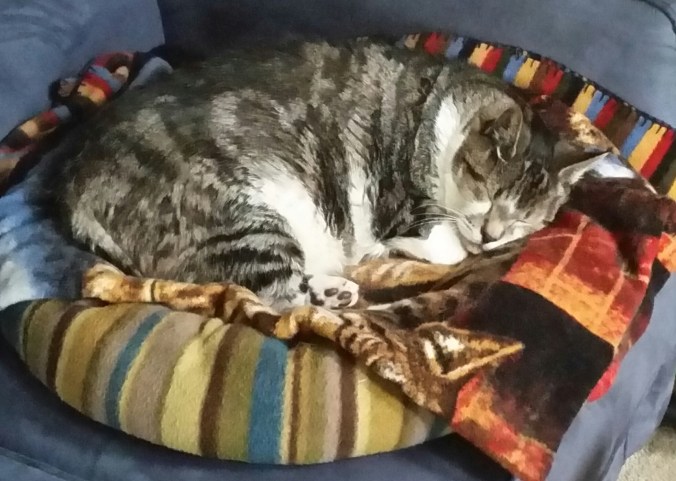
2017-09-04 15.07.38

Your cat curls up for a nap. As he drifts off to sleep, his mind races across galaxies, through the time-space continuum. His intelligence, far superior to that of a mere human, unravels the mysteries of the universe as he is immersed in the infinite wisdom of the quantum field.

As he returns to the mortal plane of existence, he walks into the kitchen,  prepared to explain the origins of the universe.  Being much smarter than us, cats can speak an unlimited number of human languages, but prefer to communicate with one another using the much more complex dialect our limited comprehension interprets as “meow.”

Your cat is about to explain how the concepts of the Big Bang and Intelligent design are actually compatible, when he hears, “Does kitty want a treat?”  or “What are you meowing about? Does your litter box need to be cleaned?” Although cats are very intelligent, they are easily distracted. Your cat forgets what he was about to tell you and is more than pleased that you’re opening a bag of his favourite treats or going downstairs to clean his litter box.

All across the face of the Earth, scientists are missing the opportunity to finally understand the mysteries of the universe, because they’re too busy opening cat food cans and scooping litter boxes.

Copyright © 2017 by J. Paul Cooper


Libraries And The Economy

When libraries ask for funding from any level of government, it’s an uphill battle. Politicians like to have their names prominently displayed on signs next to public works project; building new roads, repairing sewer systems. You can’t blame them, it’s how they get re-elected and keep their jobs. What makes it so challenging for libraries is that the phrase “non-profit organization” doesn’t excite government leaders who are trying to convince the public they are creating jobs and growing the economy. And yet, libraries do contribute to the economy!
Libraries provide employment for their staff. If there are twenty staff members. that’s twenty citizens who are earning a living, spending money at local stores and not competing for scarce employment opportunities in the community. Hiring student volunteers also contributes to local economy; they learn the importance of being punctual, they learn how to take directions and they develop useful interpersonal skills. At the library, they learn the basic skills they need to be successful in the workforce.
Writers may be thought of as artists, but they are also entrepreneurs; their books are products they promote in the marketplace. By not only purchasing books by local authors, but also inviting them to lead seminars and participate in public readings, the library is helping writers promote and sell their products. If a local writer becomes successful, she’ll be buying a new car at a local dealership and making travel arrangements for her book tour through a travel agency in your town. If the writer includes references to your town in the book, it will help put your town on the map and generate tourism revenue.
Libraries aren’t given enough credit for how they help shape the future of the economy. If someone has an interest in starting a bakery, but doesn’t have the resources to attend a culinary school, he can begin the process by going to the local library and borrowing recipe books. Who knows what might result from just starting the process; a new local bakery, or a national franchise with it’s headquarters in your town.
A student attending high school has an interest in Engineering, but isn’t quite sure it’s the path she should follow. Fortunately, she can borrow books about the subject from the library to help her make that important decision. A lot of time, effort and money can be saved by going to the local library and doing some research. If you read books or watch videos by motivational experts like Tony Robbins and Jack Canfield, they stress the importance of finding your gift, the natural ability that you can develop into a successful career. When someone uses the resources of their local library to discover and develop their talents everyone benefits; new businesses are created, and with them, job opportunities.
The most important way libraries contribute to the economy, however, is how they encourage people to let their imaginations run free. We spend so much of our lives being told what to do, what schedule to follow, and what to believe. If we want the economy to grow, we need citizens who can imagine a better future, design new products, and create new industries. It all begins with the question, “What If?” and that’s a question that all libraries encourage us to ask.

Libraries have been an important part of my life for many years, so I’m excited that my eBook, What If? A Collection of Short Fiction by J. Paul Cooper is available as a download through several libraries in Canada and the United States.  I’ve enjoyed learning about new authors through the books I’ve borrowed and now readers are borrowing my eBook.

Copyright is important to me, so please give me credit if you choose to quote from any of my blog posts. I’ve seen my eBook listed on several websites offering “free” eBooks, but I haven’t tried downloading it. It’s possible hackers are using the promise of free books as an opportunity to download Trojan viruses on computers.

Hoping that this week you’ll find time to write and share your voice with the world.

J. Paul Cooper


The Part-Time Grind

As a writer, it’s frustrating to see the same story ideas being recycled. You go to the theatre and so many of the posters advertise films that are either another installment of a popular franchise or a remake of a film made twenty or thirty years ago. It’s frustrating because you have so many story ideas that you want to share with the world; your imagination is unlimited, but the amount of time available to you is not.

If all writing involved was actually writing, the process wouldn’t be so complicated or time consuming, but a writer is essentially an entrepreneur. The writing process requires you to develop your ideas, create a product, submit that product to the marketplace, follow up on  submissions, and if they are rejected, find new markets for them.  So what do you do, if you have a job that takes up forty or more hours of your week?

First, you’re going to have to choose which project to make the main priority. At present I’m working on a science fiction novel. I have a couple of screenplay concepts I’d love to be working on as well, but if I don’t concentrate on the novel, I will never finish it.

Second, you have to commit to finishing the project. You have to decide that even if you only have a short time each day to write, you’re going to keep at it until it’s ready to submit to an editor or producer. Keep in mind that nothing you write will be perfect, so although it’s important to do your best, at some point you will have to submit the work and see what happens.

Third, don’t compare yourself to other writers. If you convince yourself you’re a lousy writer just because someone finishes a project faster than you, you’re likely to become discouraged and give up. That would be a shame, because the world needs to hear your unique voice and your circumstances will never be exactly the same as those of another writers.  It’s like the feeling you get when driving a used car and someone passes you  driving a brand new sports car. You feel jealous for a moment, until you realise he may be driving $100,000 of debt.

As I mentioned in an earlier post, the best description of the writing process I’ve found is an address by Canadian science fiction writer, Robert J. Sawyer. If you look up his name on http://www.youtube.com you’ll find the videos listed as Robert J Sawyer-P1 of 3-OWC2010, Robert J Sawyer-P2 of 3-OWC2010, and Robert J Sawyer-P3 of 3-OWC2010. OWC stands for the Ontario Writers’ Conference and each video is about ten minutes.  I hope you’ll find time in your busy schedule to watch these three short videos. His website, http://www.sfwriter.com also has some great resources.

Keep writing, world needs to hear your unique voice. If you choose to use this essay, or quote from it, please remember to give me credit for my efforts.

Copyright © 2017 by J. Paul Cooper


God, The First Writer

Note: When I use Him or His when referring to God, it’s to avoid using it. To the best of my understanding God is a spirit and therefore doesn’t have a gender. To be clear, I am referring to the God of the Bible, not some nondescript infinite spiritual being. Atheists don’t apologize for dismissing the concept of God, I don’t apologize for believing in God.

So God decides to write the Ten Commandments. One of the greatest challenges for writers is brevity, keeping your message succinct; a one page cover letter to an editor, a two sentence logline to pitch a movie concept to a director. God manages to write a moral code for the human race in ten brief directives.

Where does God write the Ten Commandments? On a mountainside, and He makes it perfectly clear no one, except His friend Moses is allowed on the mountain while He is writing. You can probably relate; you want to be able write undisturbed, preferably in a room with the door closed. So why would God invite Moses to join Him? Proof of authorship; Moses was a witness to the fact God was the author.

It’s a good thing that God considered Moses a friend, and that He accepts human emotions and frailties. On the way back down the mountainside the first time, Moses sees his people worshipping an idol, a golden calf, and breaks the first stone tablets.  God allows Moses to return to Mount Sinai and writes the Ten Commandments on a second set of stone tablets.

When Moses walks down Mount Sinai with the Ten Commandments a second time, his face glows to the point people are afraid to approach him. Why was that necessary? The problem was someone could have claimed that Moses thought up the Ten Commandments by himself, and they weren’t really God’s words.  His glowing face made a clear and undeniable statement: The Ten Commandments, Copyright God.

If you choose to quote from my blogs, please remember to give me credit. I can’t clear a mountain to write, but I do my best.

Copyright © 2017 by J. Paul Cooper


Writing Formats: The Keys To Your Potential

Note: This article was originally published in the July 2017 issue of Opal: The Canadian Magazine For Authors and Writers. http://www.opalpublishing.ca.

The potential of the creative mind is infinite.

As the setting sun dips below the horizon producing a red glow, one writer imagines two lovers walking along a beach holding hands. Another writer imagines the red glow of plasma engines on a starship, delivering the alien horde about the annihilate the human race. Both stories can have a happy ending.
With time and practice, anyone who applies themselves and is dedicated to their craft can develop a unique voice and become an excellent writer. Although your mind constantly overflows with creative ideas, there is one factor which can limit the opportunities available to you; the number of formats you are familiar with.
It isn’t an issue of lack of talent, it’s about how quickly you can respond to opportunities. If you see an announcement for a playwriting competition, and you have a great story idea, you can write the play while you’re learning the format, but it will take longer. It will be a much less stressful experience if you already understand the format for writing a play for live theatre.
Another good reason to experiment with various formats is that it may help you find which format you’re most comfortable working with. Several years ago I was writing a crime novel and now matter how many times I started, I always found myself stifled by writer’s block. I had recently read a couple of screenplays just out of curiosity, so I decided to write the story as a screenplay, to see how it would work out. A couple of months later I had a completed feature length screenplay and I discovered my favourite writing format. Since that time I’ve written several screenplays, submitting them to producers and directors. Screenwriter, poet, playwright; you can wear all those hats!
An excellent way to develop an understanding of different formats, discover how they relate to each other, and how they are adapted for movies, is to use the following process: Read the source material (if it’s an adaptation), read the screenplay, and then watch the movie. You can begin by searching your local library’s catalogue and find out which screenplays are available. Use “Motion Picture Plays” as the subject and “Screenplay,” as a keyword. Some books about making movies also contain complete screenplays or excerpts. If you search using a movie title, keep in mind that the source material’s title may not be the same as the movie title. The 1982 movie Blade Runner was based on Philip K. Dick’s novel, Do Androids Dream of Electric Sheep?
You can buy screenplays, but it’s better from a cost perspective to see if the library has the screenplays you want to read first. There are websites that allow you to read screenplays, but I can’t vouch for how safe they are. Your library will also have books on how to use the different formats. If you’re not sure if a movie is based on an original screenplay, visit http://www.imdb.com. On each movie’s webpage you’ll find the Writer(s) listed below the Director, including who wrote the screenplay, as well as the title and author of the source material, if it’s an adaptation.
The reason this process is such a useful learning tool is because of the wide variety of formats you’ll be exposed to. Arrival (2016) us based on the short story, ”Story of Your Life,” by Ted Chiang. A Few Good Men (1992) is based on a play by Aaron Sorkin, who also wrote the screenplay for the movie. All The President’s Men (1976) is based on the non-fiction book by Carl Bernstein and Bob Woodword. Adaptations can also be based on magazine articles, an individual’s personal journal entries and poems.
Whether it’s based on an original screenplay or an adaptation, it’s fascinating to learn how the writers and directors, all storytellers, approach the same story.
Are you wondering why I said a story about aliens annihilating the human race could have a happy ending? An alien writer published her memoire of the invasion, The Day Humans Died. The memoire became an inter-galactic bestseller and she became filthy rich. In real the real world, the lawyers get all the money.

J. Paul Cooper


Are You a Writer?

Every condition has symptoms. Here are some that may indicate you are a writer.

Everything around you makes you think of a storyline. You look at a ship in the harbour, and immediately wonder what it would be like if you were a customs officer inspecting a ship, and found a nuclear weapon.  You’re riding in the backseat of a friend’s car, and you wonder what if would be like if you were a wealthy entrepreneur being driven to meeting where you’d either become a billionaire, or lose the company you’d built from scratch. It never ends.

Once you have a story idea, you can’t relax until you start writing.  A story idea in a writer’s mind  is like a marble in a tin can, the irritating rattle won’t stop until you start writing. You probably have more story ideas than you can possibly work on at one time. One option is to write a brief outline of each idea and see where it leads; your intuition will guide you to the story idea that has the greatest potential. Just the process of recording story ideas and making a decision really helps.

You remember the names of characters better than the names of real people. If I meet someone today, there’s a very good chance I’ll almost immediately forget it, but I can remember the names of characters from stories I wrote years ago. It may be that when you’re writing, you repeat a character’s name over and over again in your head.  It’s also possible that you associate a character’s name with very strong emotions, because of what happens to a character in a story.

You find it extremely frustrating to watch writers accepting awards.  If you watch someone holding a winning lottery ticket, there’s no personal connection, it’s pure math; so many tickets were issued, someone had to win, it was that guy or girl. There was nothing the person standing before you could possibly do to improve the odds, other than spending a lot of money on tickets. It doesn’t indicate any talent or intelligence. The writer accepting an award, however has followed the same process as you; start with great story ideas, write, have your work rejected, keep writing, and repeat until you’re standing at the podium accepting the award.  (Why haven’t I won any awards? How about that weather…..)

I should warn you, if you are a Writer, the condition is permanent.

J. Paul Cooper


What If?

“What If?” is the most powerful question that any writer can ask. This simple phrase is the catalyst that opens the mind to an endless world of possibilities.

When screenwriters are pitching movie concepts to producers, they always begin with the logline, a one or two sentence description of the story. Even though they don’t usually use the words, “What If?”, that’s the basic concept.  To illustrate how useful the concept is, take a moment to think about your favourite novel or movie. How would you describe the plot in one sentence, beginning with the phrase, “What If?”  For Titanic, my best guess would be: What if a young woman engaged to a man from a wealthy family, fell in love with a poor artist travelling on the Titanic?

I remember watching the original Star Trek series with scenes where Captain Kirk was talking to a Star Fleet commander on a computer screen. In order for that to be written into the script, someone had to ask  himself or herself, “What if future technology will allow people to talk to each other face to face through computers?” Now it’s no big deal, but at the time it seemed like amazing technology.

The reason “What If?” is so effective for fiction writers, especially science fiction and fantasy writers, is because it doesn’t imply any limitations. You’re writing a novel and you ask yourself, “What if the largest predator on the planet where my heroine has been stranded has huge razor sharp teeth, spits acid and can both fly and swim?” By continually asking “What If?” you can raise the tension and keep your readers up all night turning pages.

I hope this week you’ll spend some time asking, “What If?” and create great literature. Since it’s probably a cardinal sin for a writer to miss an opportunity to market his or her writing, I should mention the title of my eBook is What If? A Collection of Short Fiction by J. Paul Cooper. You can purchase a copy through Smashwords or other online eBook retailers, or you can ask your local library to order it through Overdrive or Cloud Library.


Stories Are All Around You

One characteristic that all writers seem to have, is tendency to be curious and notice details in their surroundings. Do you have a hobby? Are you involved in a sport? Do you attend a place of worship? You may be surprised do discover how may opportunities there are all around you. Here are some examples of how I found subjects to write about.

For several years I worked as an Airport Security Screening Guard. I offered to write an article for a local newspaper about how passengers could pass through the security screening section at the airport, with as little hassle as possible. “Have Gifts, Will Travel” was published in The Daily News (Halifax).

When I was attending a Baptist church in Nova Scotia there was a youth pastor who did some crazy stunts to encourage young people to attend their annual summer Vacation Bible Camp. A Canadian magazine, Faith Today, agreed the story was interesting and published it under the title, “Baptists Thrill Kids in Nova Scotia.”

After a karate class over ten years ago, I noticed the sensei cleaning up the dojo and asked him about what was involved in operating a martials arts club. That resulted in an article, “Black Belt and a Briefcase,” that was published in a local business magazine, Atlantic Progress.

My most recent article was “Writing Formats: The Keys to Unlocking Your Potential,” that was published in Opal: The Magazine for Canadian Authors and Writers. It helps if you’re writing about something you’re passionate about,  so readers don’t feel they are listening to someone forced to give a report about something they have absolutely no interest in.

Writing is about paying attention to the world around you and taking advantage of the opportunities you find. If you’re a student and you wonder what it takes to coach a high school soccer team,  that’s a great article for the school newspaper. If it sparks your imagination and you wander how it would feel to be the first human to coach the Urzlak team on planet Voxtax, that could be a great science fiction novel.

Never forget, it’s your voice, your passion. Keep writing.

If you’re curious, you can find a complete list of my published writing in the Members Directory on the Writers’ Guild of Alberta website: http://www.writersguild.ca.

J. Paul Cooper


What Are Your Goals?

Even if you love to drive, just for the sake of driving, you probably have a destination in mind before you start the engine of your vehicle. There’s a certain feeling of accomplishment,  safely completing a journey. If you don’t have a destination, then all you’re doing is driving around in circles, wasting gas. If you’ve never thought about what you want to achieve through writing, perhaps now is the time to consider this important issue. Here some questions to consider:

Do you want to be a professional writer or are you content to keep writing as a hobby? There’s no right or wrong answer to this question, because no one understands your life better than you do. Although my goal is to become a full-time, professional writer, at the moment leaving my job would be unfair to my family. That’s why I start and end each shift at the warehouse with the Writer’s Daily Affirmation that I wrote in the first blog entry, to remind myself that I’m a writer, not a forklift operator.

Are you willing to write for free to get started?  It’s often been said that the worst thing that can happen to a writer isn’t being criticized, it’s being forgotten. One reason to write for free, especially when you first start writing, is earn credits that you can list in your profile.  One important thing to remember, however, is that once a story, essay or article has been published, even on your own blog, it will much more difficult to get it published again. Some editors won’t even consider previously published material. If an article or short story has been published for free, you may never be paid for it.

Do you have one project that keeps working its way into your thoughts?  Great story ideas are like marbles in a tin can, they just keep rolling around in your mind, and the rattling won’t stop until you start writing.  The most important decision you can make is to actually start writing. You can read Writer’s Digest, watch author interviews on YouTube, visit author’s websites and read blogs about writing, but never actually sit down and write. If your intuition it telling you it’s a great story idea, it’s time to start writing.

Have you ever written your goals down? Take a few minutes to write down the goals you want to achieve through writing and record dates by which you plan to achieve those goals. You don’t have to worry about whether you can finish the projects before the self-imposed deadlines, their purpose is to help you focus and avoid procrastination. The main thing is that you’re moving towards your goals.

During the first week of July I had one editor reject a short story I had submitted, and another editor publish an article I wrote. While I’m waiting to hear from several film companies I submitted screenplays to, my eBook, What If? A Collection of Short Fiction by J. Paul Cooper has been added by several libraries. Writing really is an emotional rollercoaster.

J. Paul Cooper


Stay Flexible

With so many demands on your time, it’s easy to push your dream of becoming a published writer to the end of the list and place it in the “someday I’ll” file. Here are a couple of suggestions to help you achieve your writing ambitions.

Since the most important goal is to keep writing, consider working on two projects; a longer project like a novel or feature length screenplay and a shorter project like a short story or an essay. If you feel overwhelmed by the longer project, take a break and work on the smaller project. Finishing the shorter project will give you a feeling of accomplishment, and you’ll be ready to tackle the literary behemoth again.

I’m working on a science fiction novel, but I recently took a break to write an article, “Formats: The Keys to Your Potential,” which was published in the July 2017 issue of Opal: A Magazine For Canadian Authors and Writers.

Set deadlines for your work to help you keep focused, but accept the fact that you’ll have to adapt to changes in your life. Write down what you’re writing goals are and decide when you plan to achieve them, but if you reach that deadline and you’re not finished, don’t be too hard on yourself.  If you start thinking of  yourself as a loser because you’ve missed a self-imposed deadline, it’s only going to destroy your self-confidence. You are not a loser, you’re a normal human being dealing with life. You can always set a new deadline and start writing again.

You may not have thought about it this way, but if you’re a writer, reading is like learning from the masters. Even though you aren’t doing it intentionally, you’re absorbing writing techniques as you turn the pages. Even if it’s extremely difficult to find time to write, if you’re reading, you’re still learning and making progress. You can’t read while you’re driving to work, but you can listen to books on CDs.

Learning to write is a lifelong process, so you don’t have to become discouraged by unexpected delays. If life prevents you from writing for a while, you won’t forget how to write; you are still a talented, intelligent individual prepared to share your unique voice with the world.

J. Paul Cooper